


Beyond Beauty: How the Arts Shape Thought, Culture, and Everyday Life
What We Mean by “the Arts”
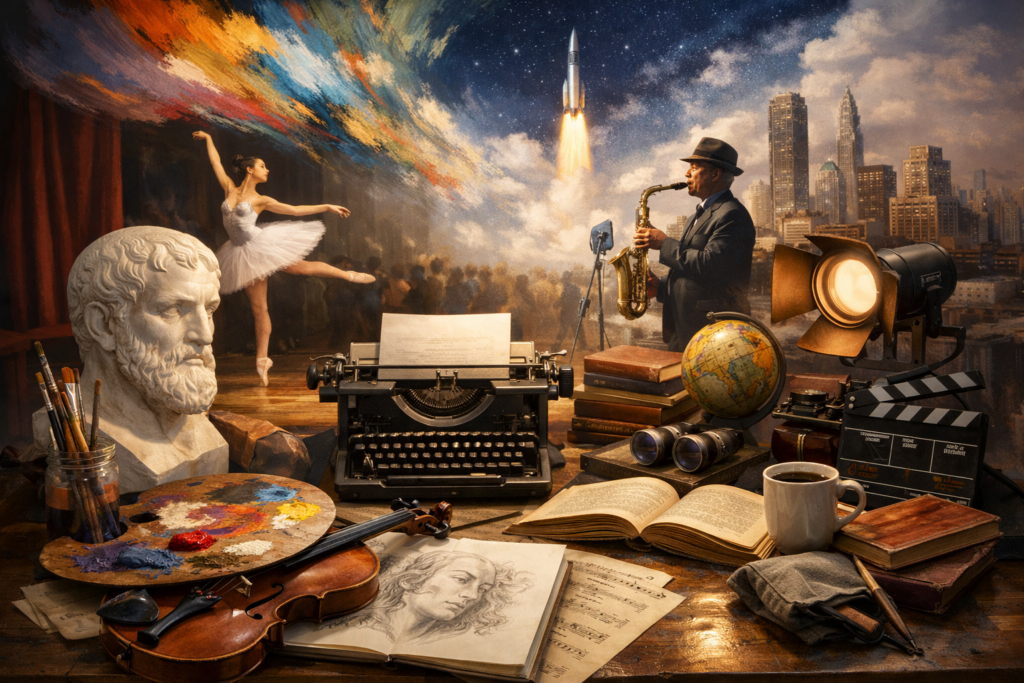
The arts describe a broad family of creative practices that use skill, imagination, and intention to produce expressive works. They include long-established forms like painting, music, theater, dance, literature, architecture, and sculpture, as well as newer forms such as film, photography, graphic design, animation, video games, and immersive digital experiences. While these fields differ in technique and materials, they share a common aim: to communicate ideas and emotions through crafted form.
Importantly, the arts are not only objects to be admired. They are also processes—ways of exploring identity, questioning norms, and building shared experiences. A mural can tell a community’s story; a song can carry a language across generations; a performance can bring audiences into emotional and ethical reflection. In every case, the arts turn inner life into public meaning.
Major Branches of Artistic Practice
Visual Arts
Visual arts focus on what we see: images, objects, and spaces. This includes drawing, painting, printmaking, sculpture, installation, and contemporary practices that blend materials and media. Visual arts often balance technique (composition, color, light, proportion) with concept (symbolism, narrative, critique). A single work can function as decoration, documentation, protest, or philosophical inquiry depending on context and audience.
Performing Arts
Performing arts are time-based and embodied, unfolding in front of an audience or camera. Theater and dance emphasize presence, movement, and interpretation; music ranges from intimate solo works to massive orchestral or electronic productions. Performance can be scripted or improvised, traditional or experimental. Its power lies in immediacy: performers and audiences share a moment that cannot be replicated exactly.
Literary Arts
Literary arts shape language into art—poetry, fiction, drama, essays, and hybrid forms. Literature can compress meaning into a few lines or build entire worlds across hundreds of pages. It expands empathy by letting readers inhabit different lives, times, and perspectives. Through metaphor, voice, and structure, writing can explore what is difficult to say directly.
Design, Media, and Applied Arts
Design and applied arts connect creativity with function: graphic design, fashion, industrial design, interior design, and architecture. These fields influence daily life as much as museums do—shaping signage, apps, clothing, furniture, and the places we live and work. Media arts such as film, photography, animation, and interactive installations add new layers, blending storytelling with technology. These practices demonstrate that the line between “fine art” and “useful art” is often a cultural choice rather than a strict boundary.
Why the Arts Matter
They Train Perception and Attention
Art teaches people to notice. A painting can sharpen sensitivity to color and form; music can refine the ear for rhythm and harmony; dance can deepen awareness of movement and space. These skills transfer beyond art itself, strengthening focus, observation, and nuanced thinking—qualities increasingly valuable in a world filled with fast, fragmented information.
They Preserve Culture and Create Memory
Communities store their stories in songs, textiles, buildings, myths, and festivals. The arts transmit values and histories when official records are incomplete or biased. Folk traditions and contemporary works alike can become cultural memory—how a society remembers, mourns, celebrates, and argues with itself across time.
They Support Emotional Health and Connection
Art provides language for feelings that are difficult to articulate. People turn to music in grief, film for catharsis, or drawing for calm. Participatory arts—singing in a choir, acting in community theater, joining a writing group—create belonging and reduce isolation. The arts also help audiences recognize shared emotions across differences, strengthening social ties.
They Encourage Innovation
Creative work involves experimentation, revision, and risk. Artists test ideas, learn from failure, and reshape materials into new forms. Those habits mirror innovation in science, technology, and entrepreneurship. When societies invest in the arts, they often cultivate broader creative confidence—an ability to imagine alternatives and build them.
How the Arts Evolve in the Digital Age
Technology has transformed how art is made, shared, and experienced. Digital tools enable new aesthetics—3D modeling, generative visuals, virtual production, and interactive storytelling. Distribution has also shifted: artists can publish music, films, and portfolios globally without traditional gatekeepers. At the same time, the digital environment raises new questions about authorship, attention, and value when works can be copied instantly and audiences are scattered across platforms.
Many contemporary artists embrace hybridity, mixing painting with projection, dance with motion capture, or poetry with audio and visual collage. This blending reflects modern life itself, where people experience culture through screens, cities, and networks all at once.
Experiencing Art More Deeply
You do not need specialized training to engage meaningfully with art. The key is curiosity and patience—allowing a work time to unfold rather than rushing to interpret it. A useful approach is to move from observation to reflection:
- Look or listen carefully: What stands out—colors, shapes, tempo, silence, gesture, mood?
- Ask what the work is doing: Is it telling a story, building tension, celebrating, criticizing, inviting participation?
- Consider context: When and where was it made, and for whom? What traditions or events might it reference?
- Notice your response: Confusion, delight, discomfort, nostalgia—your reaction is part of the experience.
- Revisit when possible: Many works reveal more on a second encounter.
Supporting the Arts in Everyday Life
The arts thrive when audiences, institutions, and communities treat creativity as essential rather than optional. Support can be practical and local: attending performances, buying directly from artists, visiting galleries, borrowing books and films, advocating for arts education, and sharing thoughtful feedback. Even small choices—displaying local crafts, learning an instrument, joining a workshop—help build cultural ecosystems where artists can sustain their practice.
Ultimately, the arts matter because they enlarge what people can feel, imagine, and understand. They offer beauty, but also clarity; entertainment, but also insight. In a changing world, the arts remain a durable way to explore what it means to be human—together.