

The Living Engine of Discovery: How Science Turns Questions into Knowledge
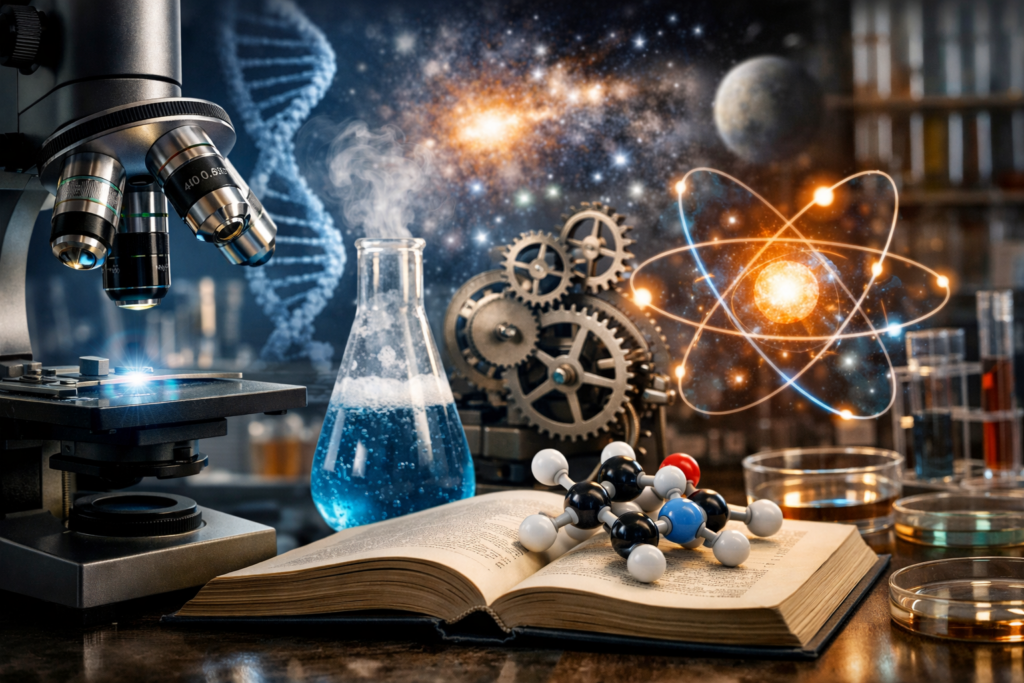
What Science Really Is
Science is often described as a body of facts—gravity, atoms, evolution, the periodic table. But at its core, science is a process: a disciplined way of asking questions about the world and checking whether our answers hold up when confronted with evidence. Scientific knowledge is valuable not because it claims certainty, but because it is built to be self-correcting. When better measurements, new observations, or stronger explanations appear, science changes its mind—openly and publicly.
This approach allows science to work across an enormous range of topics, from subatomic particles to ecosystems, from human cognition to distant galaxies. What unites these efforts is not a particular subject matter, but shared habits: careful observation, transparent reasoning, and the willingness to revise conclusions.
The Scientific Method: More Than a Checklist
The “scientific method” is often taught as a neat sequence: question, hypothesis, experiment, conclusion. In practice, it is less like a straight line and more like a loop with detours. Many discoveries begin with an anomaly—something that doesn’t fit expectations—or with a practical problem that demands a solution.
Still, several core elements show up repeatedly:
- Observation: Noticing patterns, problems, or unexpected results.
- Hypothesis: A testable explanation that makes specific predictions.
- Measurement and experimentation: Gathering data through controlled tests or systematic observation.
- Analysis: Using logic, mathematics, and statistics to interpret results.
- Replication and peer review: Checking whether findings hold up when others repeat or scrutinize the work.
- Revision: Updating theories or models to fit the best available evidence.
Importantly, not all sciences rely on laboratory experiments. Astronomers cannot manipulate stars, and geologists cannot rerun Earth’s history. Yet they can still test hypotheses by comparing predictions with observations, using multiple lines of evidence and increasingly precise instruments.
Evidence, Uncertainty, and Why Science Doesn’t Promise Perfect Answers
Scientific results often come with probabilities, error bars, and confidence intervals. That is not weakness—it is honesty. Every measurement has limitations: instruments have noise, samples can be biased, and complex systems contain variables we may not fully capture. Science addresses this by quantifying uncertainty and reducing it through better methods and more data.
Understanding uncertainty also clarifies a common misunderstanding: scientific conclusions are not “just guesses.” A well-supported theory—such as germ theory, evolution by natural selection, or plate tectonics—is not a hunch. It is a comprehensive explanation that has survived extensive testing and ties together many observations under a coherent framework.
Correlation, Causation, and the Need for Care
One of science’s most important disciplines is separating what moves together from what causes what. For instance, two variables can correlate because one influences the other, because they share a hidden cause, or purely by chance. Scientific design—randomization, controls, blinding, and robust statistics—exists largely to guard against being fooled by patterns that aren’t truly causal.
Branches of Science and How They Interlock
Science is sometimes divided into broad domains, but real progress often happens at their boundaries:
- Physical sciences (physics, chemistry) explore matter, energy, and the laws governing interactions.
- Life sciences (biology, ecology, genetics) investigate living systems from cells to ecosystems.
- Earth and space sciences (geology, meteorology, astronomy) study our planet and the cosmos.
- Social and behavioral sciences (psychology, sociology, economics) examine human behavior and societies using empirical methods.
These categories overlap constantly. Climate science blends atmospheric physics, chemistry, oceanography, and ecology. Neuroscience draws from biology, psychology, computer science, and engineering. Even fields that seem distant can connect: advances in materials science enable better telescopes; better telescopes refine cosmology; cosmology informs physics at the smallest scales.
Tools That Extend Human Senses
Science advances when our ability to observe improves. Instruments translate hidden signals into data we can analyze: microscopes reveal cells, spectrometers decode chemical fingerprints, sensors monitor seismic waves, and satellites track the changing face of Earth.
Equally transformative are conceptual tools—mathematics, modeling, and computation. Models let scientists test “what if” scenarios, explore systems too large or too dangerous to manipulate directly, and connect theory to observation. Computation also opens new modes of discovery, such as identifying patterns in massive datasets from genomics, particle physics, or public health.
How Scientific Knowledge Becomes Technology
Science and technology feed each other. Basic research uncovers principles, and engineering turns those principles into practical tools. In turn, new technology provides better instruments, accelerating discovery. This cycle has shaped modern life: electricity, vaccines, GPS, semiconductor electronics, clean-water systems, medical imaging, and renewable energy all rest on scientific foundations.
Importantly, science does not dictate how technology should be used. Ethical choices—privacy, safety, fairness, environmental impact—require values, laws, and public deliberation. Science contributes by clarifying trade-offs, risks, and likely outcomes.
Science as a Human Enterprise
Scientists are people, and science occurs within institutions and cultures. That means it inherits human strengths—creativity, persistence, collaboration—as well as human vulnerabilities, like bias and incentive problems. Practices such as peer review, preregistration, open data, and independent replication exist to reduce these issues and increase trustworthiness.
Science also benefits from diversity: different experiences and perspectives help researchers notice overlooked questions, challenge assumptions, and design studies that better reflect the real world.
Why Scientific Literacy Matters
In a world saturated with information, scientific literacy is not about memorizing formulas. It is about understanding how claims are evaluated. A scientifically literate person asks: What is the evidence? How was it measured? Could there be alternative explanations? What uncertainties remain? These habits help people navigate health decisions, evaluate environmental claims, and interpret new technologies.
Conclusion: A Way of Thinking That Keeps Learning
Science is best understood as a living engine of discovery—built on curiosity, disciplined by evidence, and strengthened by correction. It does not offer perfect certainty, but it consistently offers something more useful: methods for reducing error and improving our understanding over time. In that sense, science is not merely a collection of answers. It is a commitment to keep asking better questions—and to let the world, through evidence, shape the reply.