

The Living Thread: How Arts Shape Culture, Memory, and Tomorrow
What We Mean by “Arts”
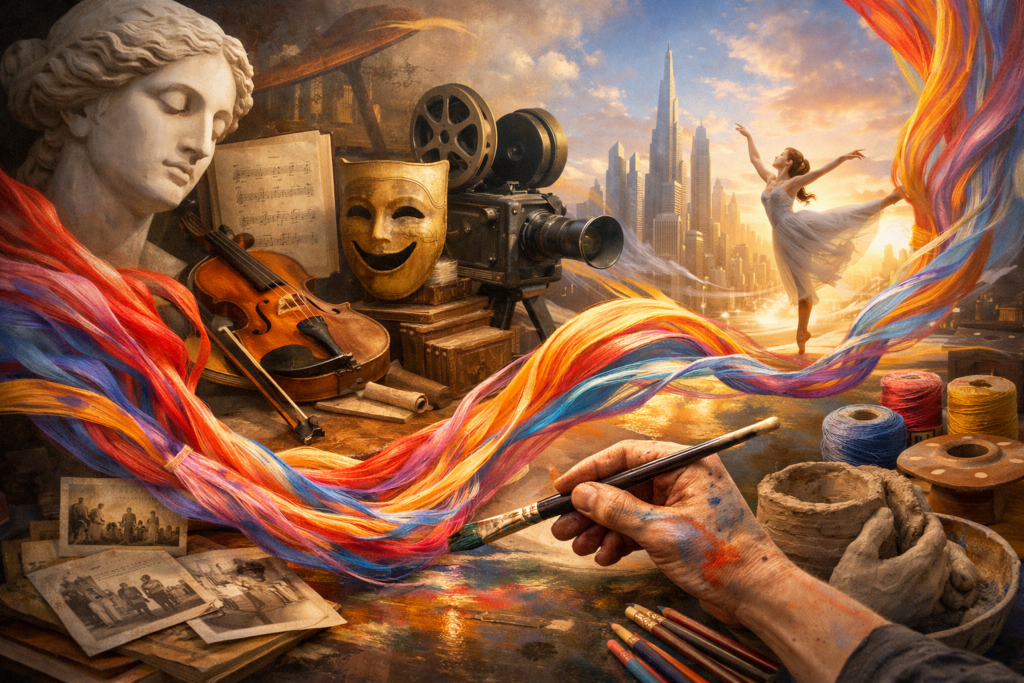
The arts are a broad family of human practices that transform ideas, emotions, and observations into forms that can be experienced—seen, heard, read, performed, or inhabited. They include familiar domains such as painting, music, theater, dance, literature, film, and sculpture, as well as newer or hybrid forms like digital illustration, interactive installations, game design, and mixed-media performance. While each discipline uses its own techniques and materials, the arts share a common goal: to communicate meaning through crafted experience rather than purely utilitarian function.
Importantly, the arts are not separate from daily life. They influence how we dress, design objects, tell stories about our communities, and even how we mourn and celebrate. Art can be quiet and personal, or public and political. It can preserve tradition, challenge norms, or invent new ways of seeing.
Major Branches of the Arts
Although categories overlap, grouping the arts helps clarify how different forms communicate and how audiences engage with them.
- Visual Arts: Painting, drawing, photography, printmaking, sculpture, ceramics, and contemporary installation art.
- Performing Arts: Theater, dance, opera, spoken word, performance art, and live music.
- Literary Arts: Poetry, fiction, essays, plays, memoir, and other forms of written storytelling.
- Media and Screen Arts: Film, animation, television, video art, and increasingly, immersive media.
- Design Arts: Graphic design, fashion, architecture, product design, and typography—where beauty and function often meet.
These branches frequently converge. A film blends writing, acting, music, costume design, cinematography, and editing. A museum exhibition may combine sculpture, sound, and projected video. A video game can involve illustration, narrative, musical composition, and interaction design.
Why the Arts Matter
They build cultural memory
Arts record what a society values, fears, loves, and debates. Cave paintings, epic poems, folk songs, and murals serve as archives that outlast political speeches and news cycles. Even when facts are incomplete, artworks preserve perspectives: what it felt like to live through a certain moment, how people imagined the sacred, or what they considered beautiful.
They make complex ideas emotionally legible
Art often conveys what data cannot. A novel can immerse readers in a moral dilemma; a dance performance can express grief without a single word; a photograph can crystallize a social issue into one unforgettable image. By giving shape to emotion, the arts help audiences process experiences that might otherwise remain abstract or overwhelming.
They support individual development
Engaging in arts practice—learning an instrument, sketching, acting, writing—builds skills that travel well beyond the studio. Artists train attention, patience, and craft. They learn to revise, accept feedback, and tolerate ambiguity. For many people, artistic practice also provides a sense of identity and belonging, especially when it connects them to community traditions or shared stories.
They strengthen civic life
Public art, festivals, libraries, theaters, and cultural centers create gathering spaces. These spaces can reduce isolation and encourage dialogue among people who might not otherwise meet. At their best, the arts allow disagreement to be explored with nuance—through metaphor, character, and multiple viewpoints—rather than reduced to slogans.
The Creative Process: From Spark to Craft
Creativity is often romanticized as sudden inspiration, but most art is built through repeated decisions and refinement. While processes vary, many creators move through a few recognizable stages: exploration (gathering ideas and references), experimentation (trying forms and materials), composition (making structure and intent clearer), and revision (tightening choices to strengthen impact). Craft matters because it turns vague intention into a shareable experience.
Constraints can also fuel creativity. A poet writing within a strict form, a filmmaker working with a limited budget, or a designer restricted to a small color palette may discover inventive solutions. In this way, limitation becomes a tool rather than a barrier.
Arts in the Digital Age
Digital tools have expanded access to both creation and distribution. A musician can compose, record, and release work from a bedroom studio; a visual artist can reach international audiences through online platforms; a writer can serialize stories or publish independently. At the same time, the digital ecosystem raises new questions: Who owns creative work? How do algorithms shape taste? What happens when images, voices, or styles can be replicated at scale?
New media have also enabled forms that were previously impossible. Interactive art can respond to audience movement. Virtual and augmented reality can place viewers inside narrative worlds. Data visualization can become aesthetic as well as informative, turning numbers into patterns that invite interpretation.
Arts Education and Access
Arts education is not only about training professional artists; it is about teaching people to perceive and interpret. Learning to read a painting, analyze a film, or perform in an ensemble develops visual literacy, listening, and collaboration. These skills matter in a world saturated with images and persuasive narratives.
Access remains uneven. Geographic location, income, disability accommodations, and cultural representation all affect who feels welcome in arts spaces. Efforts to broaden participation include community workshops, free public performances, inclusive casting and programming, multilingual interpretation, and funding models that support emerging artists from underrepresented backgrounds.
How to Engage with the Arts (Even If You “Aren’t an Art Person”)
- Start small: Visit a local gallery, attend a school play, or watch a short film festival online.
- Practice looking and listening: Spend a few minutes with one artwork. Notice mood, composition, rhythm, and what you’re curious about.
- Learn a little context: A brief note about the artist’s time, tools, or influences can deepen appreciation without dictating meaning.
- Try making something: Sketch, write a paragraph, learn basic chords, or take a beginner dance class—process builds empathy for craft.
- Discuss, don’t decode: Ask what an artwork makes you feel or think. Multiple interpretations can coexist.
A Future Shaped by Imagination
The arts endure because they answer a persistent human need: to make sense of life through form. They help communities remember and reimagine, comfort and confront, celebrate and question. In a rapidly changing world—where technology accelerates and identities are constantly negotiated—the arts remain a vital space for reflection and invention. Supporting them is not a luxury; it is an investment in the shared language through which societies understand themselves and envision what comes next.