

The Living Language of Arts: How We Make Meaning Beyond Words
What We Mean by “Arts”
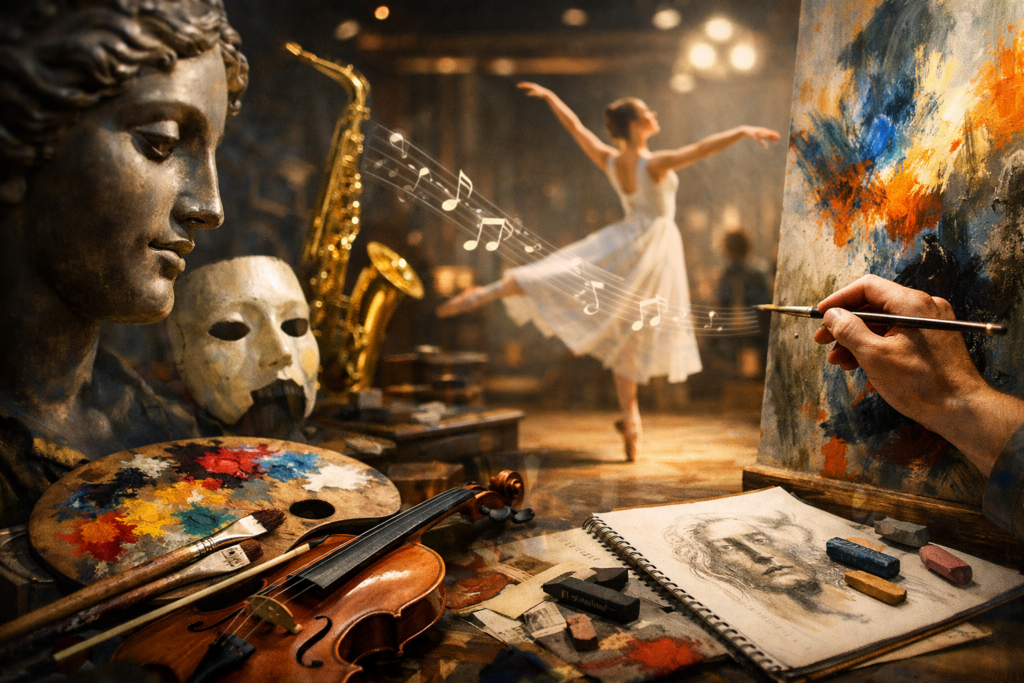
The arts are the many ways humans create and share meaning through form, sound, movement, image, and story. They include widely recognized disciplines—painting, music, theater, dance, literature, film, architecture, and design—along with emerging practices such as digital art, interactive media, and performance hybrids. Across all these forms, art uses craft and imagination to transform experience into something communicable: a feeling, an idea, a question, a memory.
Unlike purely informational communication, art invites interpretation. Two people can encounter the same painting or song and come away with different, equally valid insights. That openness is not a flaw; it is a feature that makes art resilient across cultures and time periods.
Core Functions of the Arts in Society
Art persists because it does important work—personally and collectively. While individual pieces may be made for beauty, protest, ritual, or experimentation, the broader ecosystem of the arts performs several recurring functions.
- Expression: Giving shape to emotions and experiences that are difficult to explain directly.
- Reflection: Holding up a mirror to social norms, personal identity, and shared anxieties.
- Connection: Creating empathy by letting audiences inhabit another perspective.
- Memory: Preserving stories, histories, and community values through symbol and narrative.
- Innovation: Testing new forms, tools, and aesthetics that can influence other fields.
- Ritual and belonging: Marking celebrations, grief, transitions, and communal identity.
Major Art Forms and What Makes Them Distinct
Visual Arts
Visual arts—such as drawing, painting, sculpture, photography, and printmaking—speak through composition, color, texture, scale, and material choices. A small charcoal sketch can feel intimate and immediate, while a monumental sculpture can shape how a public space is experienced. In contemporary practice, “visual art” often expands to include installations and mixed media that surround the viewer, turning observation into an embodied experience.
Performing Arts
Theater, dance, and live performance unfold in time and rely on presence. Even when scripted, performance can never be exactly repeated: the audience’s energy, the performers’ choices, and the environment shape each iteration. Dance communicates through movement and rhythm; theater weaves language, staging, and character; performance art often pushes boundaries by making the artist’s actions—and sometimes the audience’s participation—the central medium.
Music
Music organizes sound into patterns that can be felt physically as well as heard. Rhythm, harmony, melody, and timbre create emotional landscapes, from calm and spacious to urgent and dense. Music also carries cultural identity: instruments, scales, and vocal styles can signal community histories, spiritual traditions, and local innovations.
Literary Arts
Poetry, fiction, nonfiction, and spoken word use language for more than information—they use it for resonance. Metaphor, rhythm, voice, and structure can slow time, intensify perception, or make complex realities easier to hold. Literature is also a powerful tool for expanding the “moral imagination,” allowing readers to encounter lives they may never otherwise understand.
Film, Media, and Digital Arts
Film and media arts combine image, sound, editing, and narrative into a highly influential modern language. Digital arts extend this by introducing generative visuals, interactive experiences, virtual environments, and networked participation. These forms raise new questions: Who is the author when an algorithm collaborates? What does authenticity mean in a world of deepfakes and synthetic media? The answers are still evolving, and that ongoing debate is itself part of contemporary art.
Architecture and Design
Architecture and design sit at the intersection of art and utility. A chair, a poster, or a building must function, but it also communicates values: comfort, prestige, openness, sustainability, tradition, or experimentation. The arts of the built environment shape everyday life—often more continuously than museum experiences—through light, space, materials, and the choreography of how people move.
How Arts Shape Identity and Culture
Arts are deeply tied to identity: personal, regional, national, and diasporic. Styles travel through migration, trade, and technology, blending into new forms. At the same time, art can protect distinct cultural knowledge—languages, symbols, ceremonial practices—especially in communities that have faced displacement or erasure.
Because art influences what a society remembers and celebrates, it is never neutral. Museums, publishers, streaming platforms, and funding institutions help decide whose stories become visible. This is why representation, access, and cultural ownership are central conversations in today’s arts landscape.
The Creative Process: Craft Meets Curiosity
Many people imagine artists as driven by sudden inspiration, but most art comes from an iterative process. Drafts, rehearsals, studies, and revisions are not the boring part—they are where ideas clarify. Technique matters because it expands what the artist can express. Curiosity matters because it keeps the work alive.
- Observation: noticing detail, pattern, and nuance.
- Experimentation: trying materials, methods, and constraints.
- Feedback: learning from critique, audiences, and collaboration.
- Revision: refining choices until form and intent align.
Why Arts Education Matters
Arts education is often framed as enrichment, but it also builds essential skills: attention, interpretation, disciplined practice, and comfort with ambiguity. Students learn to make choices, justify them, and accept that multiple solutions can be strong. These capacities translate into fields as varied as engineering, healthcare, entrepreneurship, and public service.
Equally important, arts education strengthens civic life. When people can read images, analyze narratives, and recognize persuasive aesthetics, they become less vulnerable to manipulation and more capable of thoughtful dialogue.
Practical Ways to Engage with the Arts
You don’t need expert knowledge to begin—only time and attention. Consider these approaches for deeper engagement:
- Look slowly: Spend five minutes with one artwork and notice what changes as you keep looking.
- Ask better questions: Instead of “Do I like it?”, try “What is it doing?” and “What is it asking of me?”
- Follow threads: If something moves you, explore the artist’s influences and the context around the work.
- Support locally: Attend community performances, buy from local makers, and share their work thoughtfully.
- Make something: Sketch, write, sing, dance, or film—participation builds appreciation.
Conclusion: Arts as a Shared Human Resource
The arts are not a luxury add-on to life; they are one of the ways societies think, feel, remember, and change. They help individuals process experience and help communities negotiate values and futures. Whether encountered in a concert hall, a public mural, a novel, a video game, or a handmade object, art invites us into deeper attention—and that attention is a form of care.
In a noisy world, the arts remain a living language: precise without being rigid, emotional without being simplistic, and endlessly capable of making the familiar feel newly seen.